

Two Paths, Very Different Outcomes
This is one of the most complicated macro setups I have looked at in years, and the reason is that almost nothing lines up with a normal expansion. Manufacturing demand is holding up, but only because of a concentrated AI and robotics buildout. The consumer is clearly softening. A large share of the remaining inflation is coming from an energy shock tied to the Middle East, which is the one thing the Fed's main tool cannot touch. That leaves the economy at a genuine fork, where the same data supports two completely different outcomes depending on what happens with energy prices. Most people are still reading this like a standard cycle, and that is exactly why it is worth mapping both roads now.
No Clean Historical Comparison:
I've been digging into the current macro setup and it's one of the most complicated I've seen in a while.
In past expansions the signal was usually cleaner. The economy was running hot across the board, inflation came from strong demand, the Fed started hiking, and the cycle eventually rolled over in a fairly standard way.
Right now almost none of that lines up the same. We have a strong AI and robotics buildout that's keeping manufacturing new orders in expansion, a clearly softening consumer, inflation still heavily influenced by the energy shock from the Middle East, and a Fed that wants to protect its credibility but whose main tool doesn't actually fix the primary source of the inflation.
There's no single clean historical comparison that captures all of this at once. That's why the path from here feels so binary and why positioning has been harder than usual.
I'm working through the two main paths so we can see them more clearly: what happens if the Middle East situation continues versus what happens if we get a real resolution, and how each one would likely affect rates, the business cycle, and risk assets.
1: The Unusual Setup:
Most business cycle expansions in the past looked similar. People had jobs, they had money, they were spending, and prices rose because demand was strong across the economy. When the Fed raised rates it was responding to that broad strength.
This time the picture is different.
The parts of the economy that are doing well are concentrated. The big AI buildout, the hyperscalers, the related semiconductor and power spending, and the robotics push are real and large enough to keep the ISM manufacturing new orders index in expansion. That strength is not evenly spread.
At the same time the consumer side is showing clear softness. Retail sales recently came in weaker than expected. Regular households are not spending like they were in a classic boom.
The inflation we're still dealing with is also different. A large part of it is tied to higher energy prices and supply chain effects coming from the conflict in the Middle East. It is not mainly the result of an overheating domestic economy where everyone is buying everything.
That combination creates a K-shaped economy. The top part connected to AI and large tech capital spending is holding up. The bottom part, more tied to everyday consumers and rate-sensitive sectors, is under more pressure.
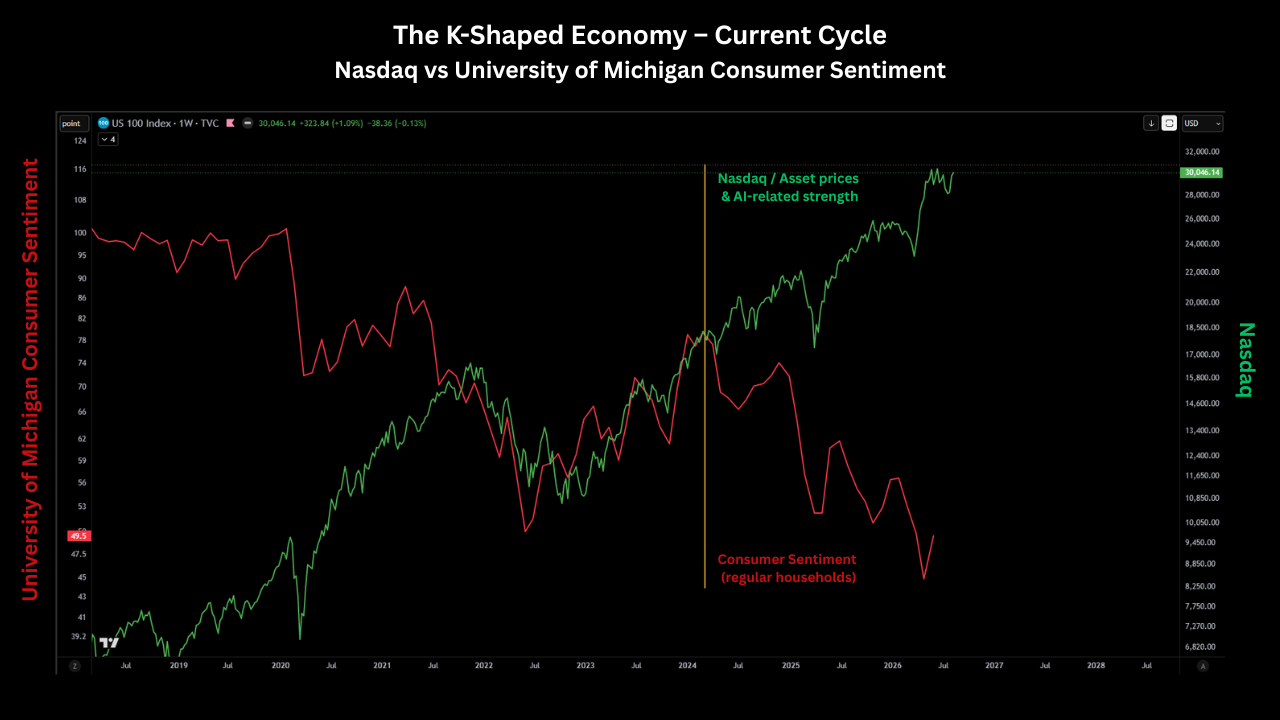
A lot of commentary still treats the situation as simple: inflation is high, so the Fed should raise rates. That view is far too simplistic for what we're actually dealing with. Raising rates would mainly hit the lower side of the K harder. It would not stop the war, lower energy prices, or meaningfully change the source of the inflation we're seeing.
You can see how concentrated that strength is in the sector breakdown that follows later in the piece.
This is why the situation feels harder to read than past cycles. The usual signals are mixed and the source of the inflation is not something the Fed can directly control with interest rates.
2. What Is Actually Driving New Orders:
One of the clearest ways to see how different this cycle really is comes from looking at which parts of manufacturing are actually driving the rise in New Orders.In a normal expansion, strength in the ISM New Orders index is usually spread across a wider range of industries. You tend to see solid contributions from categories tied to everyday consumer spending (furniture, apparel, household goods, and the materials that support them) alongside the more industrial groups.That is not what we are seeing this time.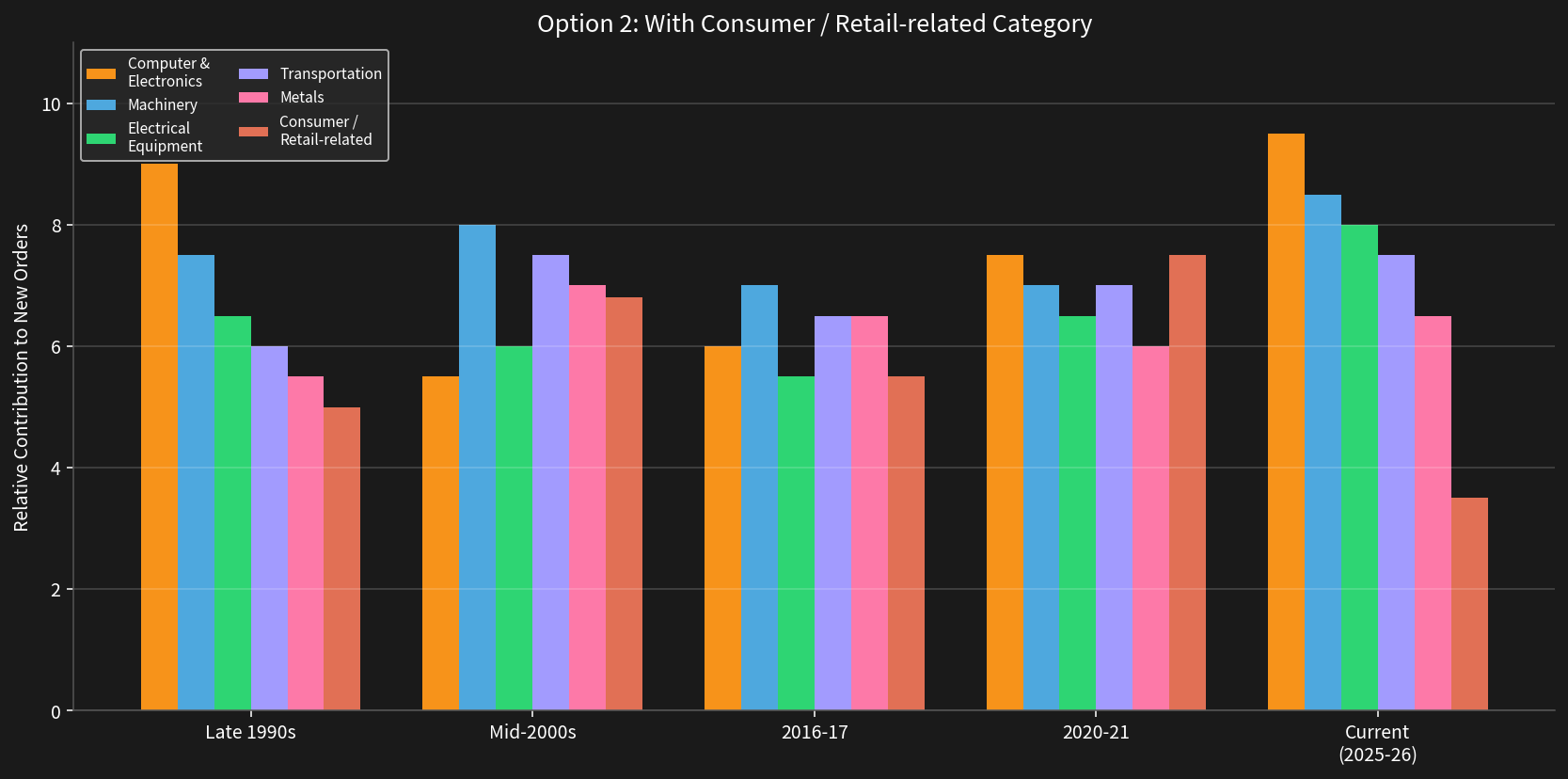 The industries leading New Orders right now are heavily concentrated in Computer & Electronic Products, Machinery, Electrical Equipment, and related capital-goods categories. These are the areas most directly tied to the AI buildout, data centers, semiconductors, power infrastructure, and robotics. The more traditional consumer- and retail-linked categories are lagging well behind where they normally sit at this stage of a cycle.
That concentration helps explain a lot of what we have been watching. The business cycle is being held up and pushed forward by large-scale capital spending rather than by regular households having cheap money and buying things. High rates have kept the lower half of the K-shaped economy under pressure, so the broad consumer strength that usually appears in a mid-cycle expansion has not shown up. The result is an expansion that looks healthy in the headline manufacturing numbers but feels very different underneath, and that difference is a big reason high-beta assets outside the largest technology names have lagged.
3. Why the Fed’s Normal Playbook Doesn’t Fit:
In most past cycles the Fed’s job was more straightforward. When the economy was running hot and inflation was rising because people were spending strongly, raising interest rates made sense. Higher rates cooled demand across the board and eventually brought inflation down. That playbook does not map cleanly onto the current situation. The inflation pressure we are still dealing with is heavily tied to energy prices and supply effects coming from the Middle East conflict. Raising rates cannot stop the conflict or increase the supply of oil. The tool simply does not reach the main source of the problem.
At the same time the economy is split. The upper side of the K, driven by large-scale AI investment, hyperscalers, and related infrastructure spending, is holding up well. The lower half of the economy is still in a wind-down and recovery phase. Most regular households never really felt the benefits of a broad bull market. They spent the last several years dealing with the damage from the high inflation that followed the COVID period and then with the high interest rates that came afterward. In many ways they are still reeling from that sequence.
That reality matters a great deal when the Fed is deciding what to do next. Strength in parts of the stock market and in the AI buildout does not mean the overall economy is running hot. Raising rates in this environment would land hardest on the same households that have already been under the most pressure for years. It would not fix the energy-driven part of inflation, and it would not reflect the actual condition of the broader consumer. This is the core difficulty. The Fed wants to defend its credibility on inflation, but the standard tool it has available is poorly matched to both the cause of the inflation and the shape of the economy.
4. The Crossroads:
Everything we have looked at so far points to the same place. The current expansion is real but narrow. Manufacturing new orders are being supported by the AI and infrastructure buildout. The consumer side remains under pressure. Inflation is still being influenced by energy prices tied to the Middle East. And the Fed’s usual tool is poorly matched to the actual problem.
That combination leaves the economy at a clear crossroads.
 The next major move will be shaped less by the normal business cycle signals and more by what happens with the conflict in the Middle East.
A lasting resolution that brings energy prices down would open the door for the Fed to cut rates and potentially extend the cycle. Lower rates would also ease pressure on regular households that are still working through the effects of the earlier inflation shock and high interest rates. That would give more consumers the ability to participate, making the expansion less one-sided and bringing it closer to the broader cycles we have seen before. Starting to cut from the current 3.50–3.75% level would represent a mid-cycle policy pivot rather than the beginning of a new cycle or end of the current one.
Continued conflict that keeps energy prices elevated would keep pressure on the Fed to stay restrictive or even hike, pushing the cycle into a more fragile late-stage phase. These are not small differences. One path looks more like a mid-cycle period with renewed policy support. The other looks more like a late-cycle period with tight liquidity and rising risks for the weaker parts of the economy and for high-beta assets. The data we have today cannot tell us which road we will take. It can only show us that the fork is real and that the two paths lead to very different outcomes for rates, growth, and risk assets.
Section 5 – Path A: Conflict Continues:
If the situation in the Middle East drags on or escalates, energy prices stay elevated or move higher. The inflation pressure tied to oil and supply chains does not go away. In that environment the Fed stays under pressure to protect its credibility on inflation.Rates would likely remain restrictive for longer. There is also a real chance the Fed feels forced to hike again, especially if energy prices push the headline numbers higher and public concern grows.Even if that happens, rate hikes would still be a blunt and poorly targeted tool. They cannot end the conflict or bring more oil to market. The main effect would fall on the lower side of the K-shaped economy: regular households, consumers, and rate-sensitive sectors. The AI, robotics, and hyperscaler buildout that is currently supporting manufacturing and a large part of the stock market would be far less affected. In some ways higher energy prices could even speed up investment in nuclear, solar, and other power infrastructure that the big technology companies need.So the only policy move available to the Fed in this path is one that hurts the wrong part of the economy while leaving the actual source of the inflation largely untouched.Here is a simple side-by-side of how the current setup compares with the two earlier expansions we have been referencing under this more restrictive path:
| Period | What Drove New Orders | Fed Stance | High-Beta Layer |
|---|---|---|---|
| Late 1990s | Technology and capital spending | Rates rising toward higher levels | Nasdaq |
| Mid-2000s | Broad based across industries | Mid hiking cycle | Nasdaq |
| Today | AI, semiconductors, power, robotics | Restrictive, held at 3.50–3.75% | Bitcoin |
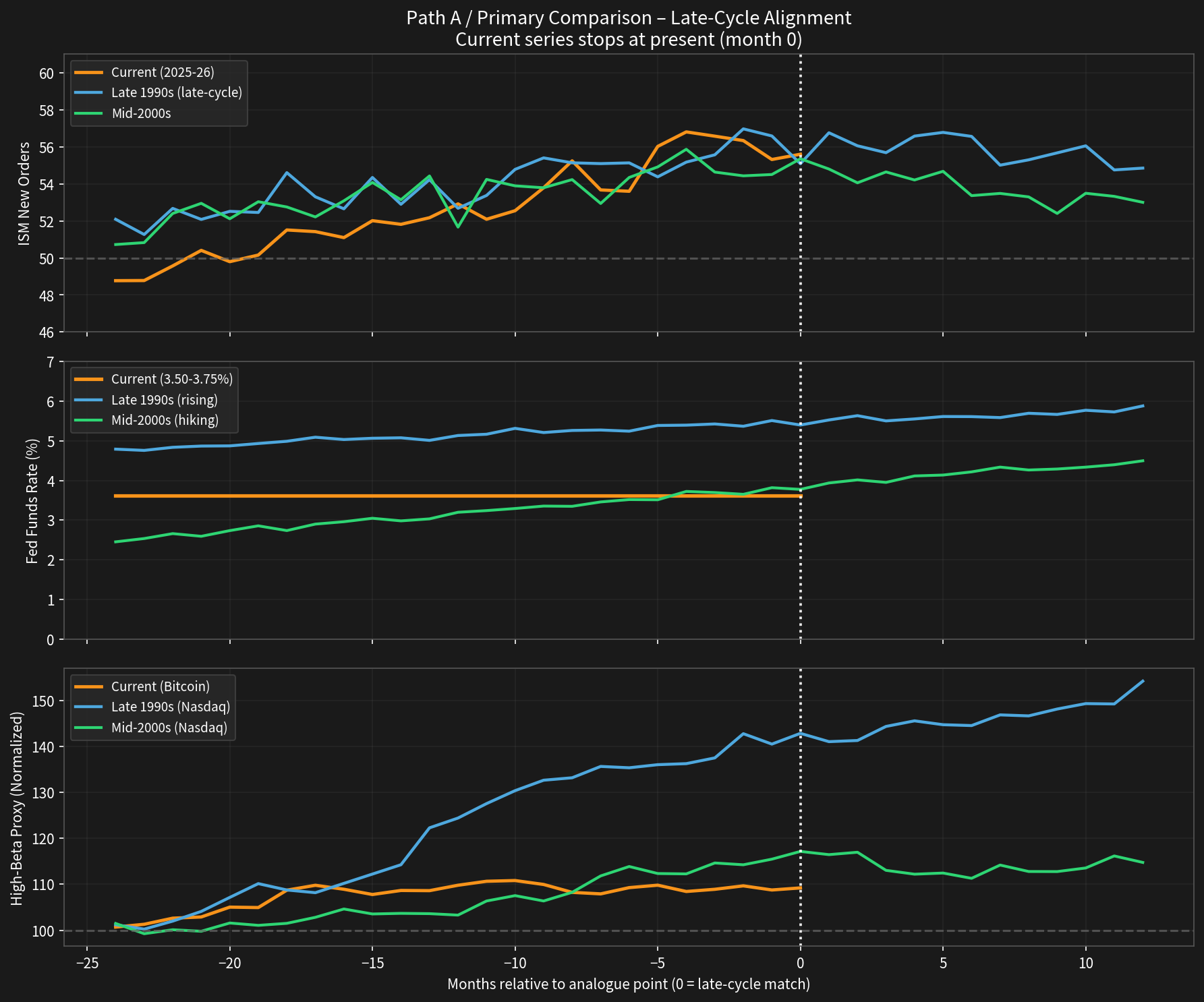
Under this path the comparison stays closer to mid-to-late 1999 and starts to look toward the year 2000. Liquidity would stay tight or get tighter. Bitcoin and other high-beta assets have already been lagging the strength in manufacturing new orders. A longer period of restrictive policy would likely keep that pressure in place and could open the door to a deeper correction across speculative parts of the market.
This path does not mean the AI spending wave ends overnight. It does mean the easy policy support stays missing and the cycle moves into a more fragile, late-stage phase where the risks of a proper risk-off period rise.
Section 6 – Path B: Resolution:
If the conflict in the Middle East reaches a real resolution, oil supply improves, and energy prices fall, the inflation picture changes quickly. The part of inflation that has been driven by the energy shock would ease. That removes the main pressure that has been keeping the Fed in a defensive stance.
In that case the Fed would have room to restart cutting rates. Liquidity conditions would begin to improve instead of staying tight or getting tighter.Here is the same style of comparison under the more supportive path:
| Period | What Drove New Orders | Fed Stance | High-Beta Layer |
|---|---|---|---|
| March 1998 | Technology and capital spending | About to cut / supportive | Nasdaq |
| March 2003 | Recovering industrial demand | Low rates, still easing | Nasdaq |
| Today (if cuts begin) | AI, semiconductors, power, robotics | Restrictive → starting to cut | Bitcoin |
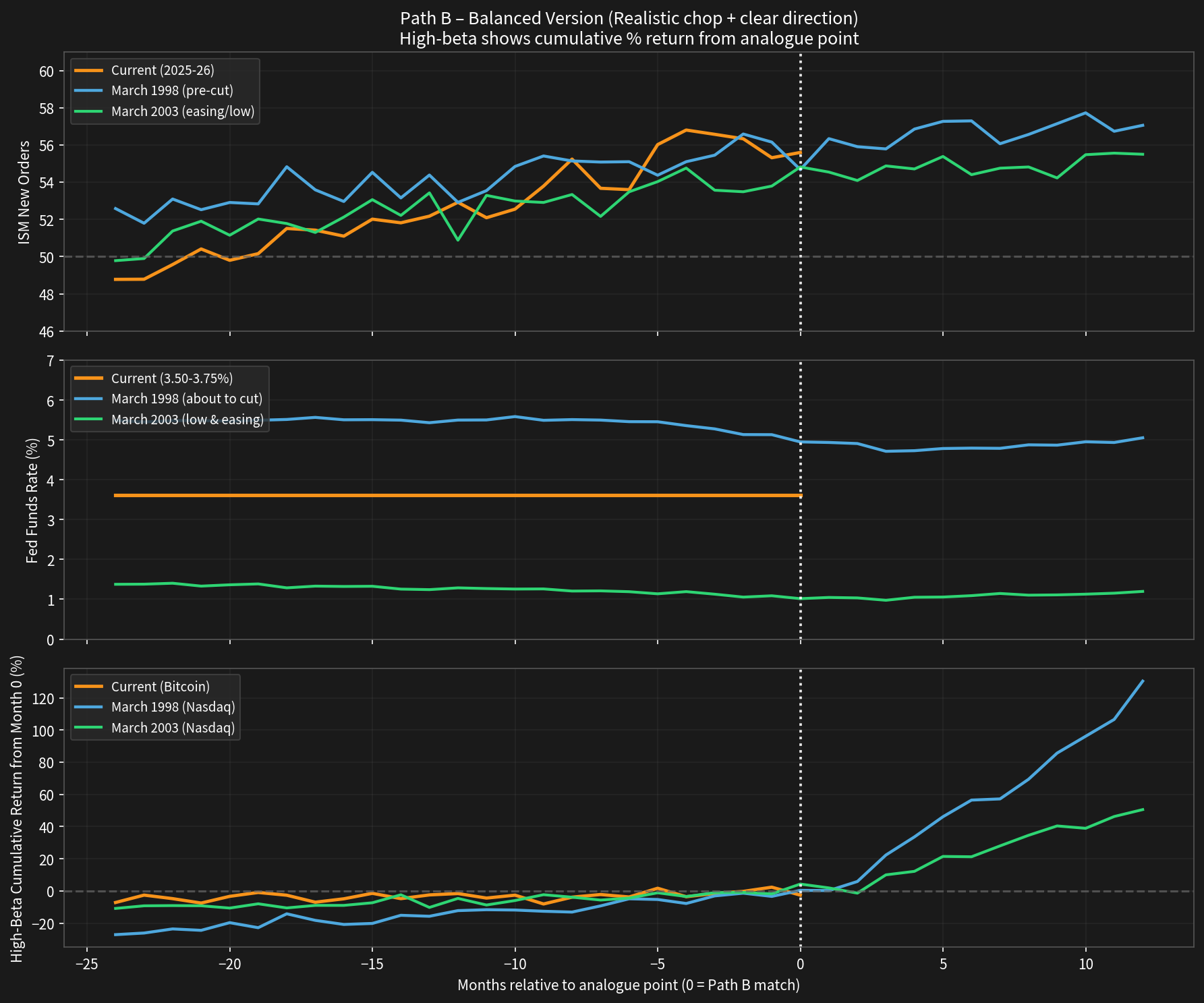 Under this path the comparison to the late 1990s shifts earlier. Instead of lining up with mid-to-late 1999, when the Fed was already hiking, the better match becomes the period around March 1998, just before the Fed began cutting. That was a supportive policy window that historically opened a strong stretch for the high-beta side of the market over the following 12 to 18 months.
The same kind of setup today would give the current AI and robotics wave more room to run and would likely allow more of the available liquidity to move beyond the largest hyperscalers into other risk assets, including Bitcoin and the broader crypto complex.
This path does not remove every risk. Valuations are already higher than they were in 1998, and the consumer side of the economy is softer than it was then. But it does reopen a more mid-cycle, policy-supported environment rather than leaving us stuck in a restrictive late-cycle corner. In short, a clean resolution in the Middle East would take the energy inflation problem off the table, let the Fed cut, and shift the entire backdrop toward a more constructive phase for both the business cycle and risk assets.
7. Implications for Positioning:
The two paths lead to different environments for both the broad economy and for risk assets. If the Middle East conflict continues and rates stay high or move higher, liquidity remains tight. The lower half of the economy stays under pressure. The AI buildout can continue, but the overall backdrop becomes more fragile. In that setting, high-beta assets such as Bitcoin have tended to struggle when policy stays restrictive and the consumer side is weak. A longer period of tight conditions would raise the odds of a deeper pullback across speculative parts of the market.
If we get a real resolution, energy prices fall, and the Fed begins cutting from the current 3.50–3.75% level, the picture improves for the lagging parts of the economy. Regular households get some relief. The expansion has a better chance of broadening beyond the hyperscalers. Liquidity conditions ease. Historically, that kind of mid-cycle shift has been more supportive for high-beta assets. Bitcoin and related markets would have a clearer path to catch up with the strength that has so far stayed concentrated in the largest technology names.
Neither path is guaranteed. The AI spending wave is large enough that it can keep manufacturing supported for a while under either scenario. But the difference in policy and in the health of the consumer side is big enough to matter for how risk assets behave over the next year or two. The practical takeaway is simple. The same data can support two very different market environments depending on what happens with energy prices and the Fed’s response. Watching that fork closely is more useful right now than treating the current expansion as a normal, broad-based cycle.
Final Takeaway:
The current expansion is real, but it is not a normal one. Manufacturing strength is being carried largely by the AI and infrastructure buildout. The consumer side of the economy is still working through the damage from earlier high inflation and high rates. A meaningful part of the remaining inflation pressure is tied to energy prices and the conflict in the Middle East. That combination has left the Fed with a tool that does not fit the problem cleanly. The Fed is standing there with their only tool, a hammer. However, this Situation is delicate, they need to be surgical, and the tool they need is a scalpel, but they don't have one.
Raising rates would hit the weaker part of the economy hardest while doing little to solve the energy shock. We are at a crossroads. One path keeps energy prices elevated, holds policy restrictive, and pushes the cycle into a more fragile late stage. The other path brings energy prices down, allows the Fed to cut, eases pressure on regular households, and gives the expansion a chance to broaden.
The difference between those two roads is large. It affects rates, the health of the consumer, the breadth of the cycle, and the outlook for high-beta assets such as Bitcoin.
Most people are still reading this moment as if it were a standard business cycle, Or much worse a standard Bitcoin cycle. The data shows it is more complicated than that. Mapping the two clear paths is the practical way to stay ahead of the next major shift.
This is not financial advice. This is just me connecting dots that I think deserve to be connected.
This article is for educational and informational purposes only and does not constitute financial advice. Always conduct your own research and consult a qualified financial advisor before making investment decisions. Cryptocurrency investments involve significant risk including the potential loss of all invested capital. Past performance does not guarantee future results.
Want the full Alpha Factory toolkit?
Live analysis, member-only articles, portfolio tools, and AI-powered research — all in one place.